
Garden Lighting

How to create a fun and functional lighting scheme so that you can enjoy your garden day and night
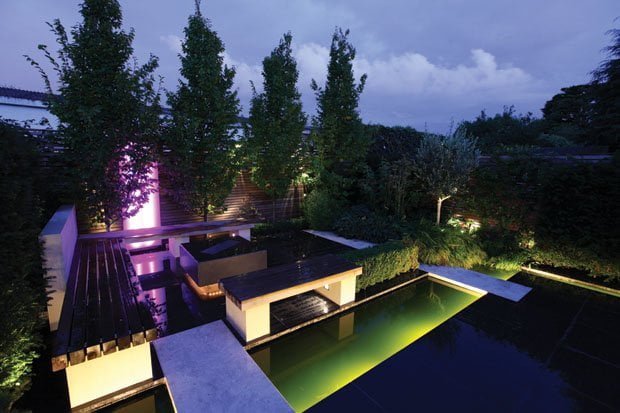
Garden Lighting
Extend your enjoyment of your outside space into the hours of darkness with an outdoor lighting scheme.

Coloured Light

Experiment with colour coordination. You can change effects by swapping tinted filters, or go for remote controlled colour-changing devices.
  • Cast coloured light on subjects in the opposite spectrum of the colour wheel (eg. red/magenta filters on green foliage) for maximum effect
  • Grade intensity from one end of a border to the other
  • Soften white and silver subjects with a champagne filter
  • Don’t mix red, blue and green filters within the same scheme as it fragments the space

Sizing Up

The system you use, size and style of light fitting, and type of lamp depends on the area or feature to be illuminated.
  • Uplight a large tree with a high power metal halide
  • Miniature 12V adjustable spotlights will fit the scale of smaller feature plants
  • Calculate the distance from the subject and angle of the beam when specifying brightness
  • Ensure that the beam fits the shape that it’s cast onto
Check that you’re not wasting intensity by casting a beam too high or too wide. The glare could also irritate neighbours.

Energy-saving Options

Solar lighting is getting better but is still not as bright or controllable as cabled lighting. The new generation of electric lamps ensure greater energy efficiency in the garden.
Alternatively, you could try rechargeable garden and outdoor table lights, or glowing globes floating on a pool.
However, the battery requires several hours to charge up fully which may not allow for a spontaneous garden party.

Weatherproof or Waterproof

To increase the lifespan of your lighting, select the correct IP (Ingress Protection) rating. This is denoted by a two-digit number which indicates the degree of weather or waterproofing of the product.
The first digit indicates protection from solids (dust, insects etc.) and the second refers to liquid ingress. For instance, IP68 is pretty waterproof, good enough to submerge or float in a pool, or bury in the ground (provided the device is surrounded by plenty of shingle, through which water can drain).
When it comes to transformers note that some are suitable for fixing to a wall or post in a vertical position, and others for lying on a surface. Beware of cheap transformers designed for indoor use only. If you must use one, fix it in an outdoor shed, and send cables out through the wall.

Professional Fitting

Too often, garden lighting installations are undertaken as DIY projects, or by electricians more used to interior electrics.
To ensure safety:
  • Use armoured cabling or reinforced conduit at the required depth (450mm below the surface)
  • In Canada you need your electrician to provide a Part P certificate to comply with Building Regulations.

Comments

Popular posts from this blog

Do I Need Automatic Revolving Doors?

Doors  – they are the first thing that people see and in one way or another set an impression about an entire building or facility. Deciding whether to depart from the traditional manual doors and upgrade into advanced automatic and revolving doors can somehow spark debates over its benefits and drawbacks. Will they require more or bigger space? Will they help ease the flow of traffic? Are these automatic and revolving doors energy efficient given that they are power driven? Installing automatic and revolving doors largely depends on different factors including the availability of space, traffic flow, compliance to  AODA  or Americans with Disabilities Act standards as well as energy efficiency. Why Are There Revolving Doors? Here are some of the benefits of installing automatic and  revolving doors  in your facility: Enhances Aesthetic Value First impression lasts. Modern and stylish doors create positive impre...

Why Your Restaurant Needs Security Cameras

Restaurants and bars make for good businesses. Everyone wants to eat and drink. Hangout with friends and family over a meal or just a cup of coffee. This makes restaurants busy places. With lots of different people coming and going all the time as well as the need for hiring a large number of employees to cater to their needs. Every restaurant owner wants to ensure the satisfaction of its customers while still turning over a profit and many factors come into play that affects both these things. Ensuring the quality of food and service as well as employee performance, security and surveillance are just some of the things that make a restaurant successful. Looking after each of these affairs while still performing your own duties can be a hard task for you. This is what makes security cameras necessary for every bar or restaurant. Installing security cameras helps you monitor the efficient running of your restaurant while giving you an eye into all its affairs. Looking after employe...

How to Fit Skirting Boards

Update an old room, or take on this essential second fix job yourself with our easy step-by-step guide Whether you plan to change the look of a room by swapping the skirting boards or take on this essential second fix job in your self-build project, you’ll find it both satisfying and relatively straightforward if you follow this DIY step-by-step guide to fitting skirting boards. If you are planning to lay a new wooden or tiled floor, do this before you fit the skirting boards for the neatest finish. If you’re carpeting, fit the skirting boards first. Carpet fitters like to have a clean, straight edge to work to and in the future you won’t have to tear the skirting boards off if you want to change the carpet. Tool List Materials Pencil Mitre saw or mitre box Coping saw Tape measure Hammer Silicone gun Skirting board Screws Instant grab adhesive Decorator’s caulk Nails Screws Drill Wood filler Step-by-step 1. Measure up the area you are fitting...